
Summary
On May 24th, SAP unexpectedly announced on the departure of its Cloud software leader Lars Dalgaard. Lars Dalgaard is leaving SAP after only 15 months in the role. SAP also announced on new leadership and organizational structure for the Cloud software organization.
SAP cloud software overview
Over the past few years Software-as-a-Service (SaaS) vendors have been rapidly taking market share from legacy on-premise (OP) software vendors. This market trend places a strong threat to legacy software companies that failed to tackle the change organically.
At 2011, SAP had only $30 million in SaaS revenue from its Cloud Business ByDesign suite. That was a small fraction of about $14 billion global SaaS revenue. To improve its SaaS market share, SAP acquired two vendors Success Factors and Ariba to reach $625 million in SaaS revenue. These acquisitions also helped improve SAP position in the Human Capital Management (HCM) and Supply Chain Management (SCM) domains.
At 2012, SaaS revenue bypassed OP revenue for the first time. According to Gartner, SalesForce, a SaaS vendor took the CRM market leadership from SAP. SalesForce grew its CRM revenue in 26% Year-over-Year, about double than the market growth of 12.5%. On the other hand, SAP YoY CRM revenue remained flat.

According to the latest Gartner CRM Magic Quadrant (MQ), SAP did not make it to the leaders quadrants. That might indicate as a reason for the mentioned above financial outcomes.
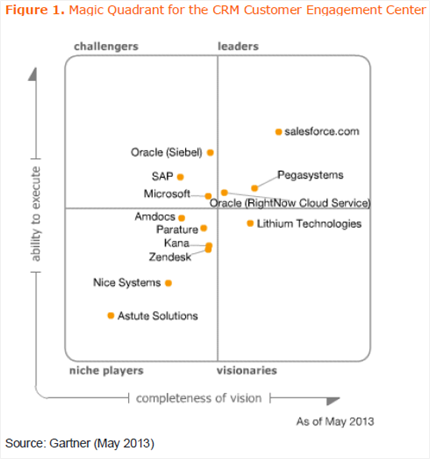
On the other hand, in the HCM SaaS front, SuccessFactors received high ranking from both Gartner and IDC.
Nevertheless, SAP ended 2012 with SaaS revenue of only $1.3 billion compared to the overall industry estimated $18 billion. With only 7.2% SaaS market share, SAP could potentially lose its software market share leadership in the medium-long term.
New Cloud leadership team
Along with Lars departure, SAP decided to revise the overall Cloud leadership team. SAP also changed its organizational structure and integrated the Cloud business and development into the overall SAP structure.
Earlier on May, SAP hired Thomas Otter to lead HCM product development. Additional changes announced with Lars’ departure included: Bob Calderoni, previously the CEO of Ariba, would lead the Cloud product Go-To-Market (GTM) organization. Rob Enslin, that leads global sales for SAP will gain additional ownership of Cloud sales. Vishal Sikka, SAP CTO, will gain additional ownership of Cloud development in addition to the overall SAP development.
Point of View (POV)
Replacing Lars Dalgaard with an SAP leadership team could lead to better integration of SuccessFactors and Ariba to the SAP structure. However, the new structure takes SAP back to the 2011 leadership and structure. The same leadership team and structure that gained SAP with only $40 million in SaaS revenue through the Business ByDesign initiative.
 IntelPOV
http://allthingsd.com/20131024/as-netsuite-beats-expectations-on-earnings-fireworks-erupt-with-sap/